
荆棘鸟
Colorado court upholds Google keyword search warrant which led to arrests in fatal arson_我的网站

A |
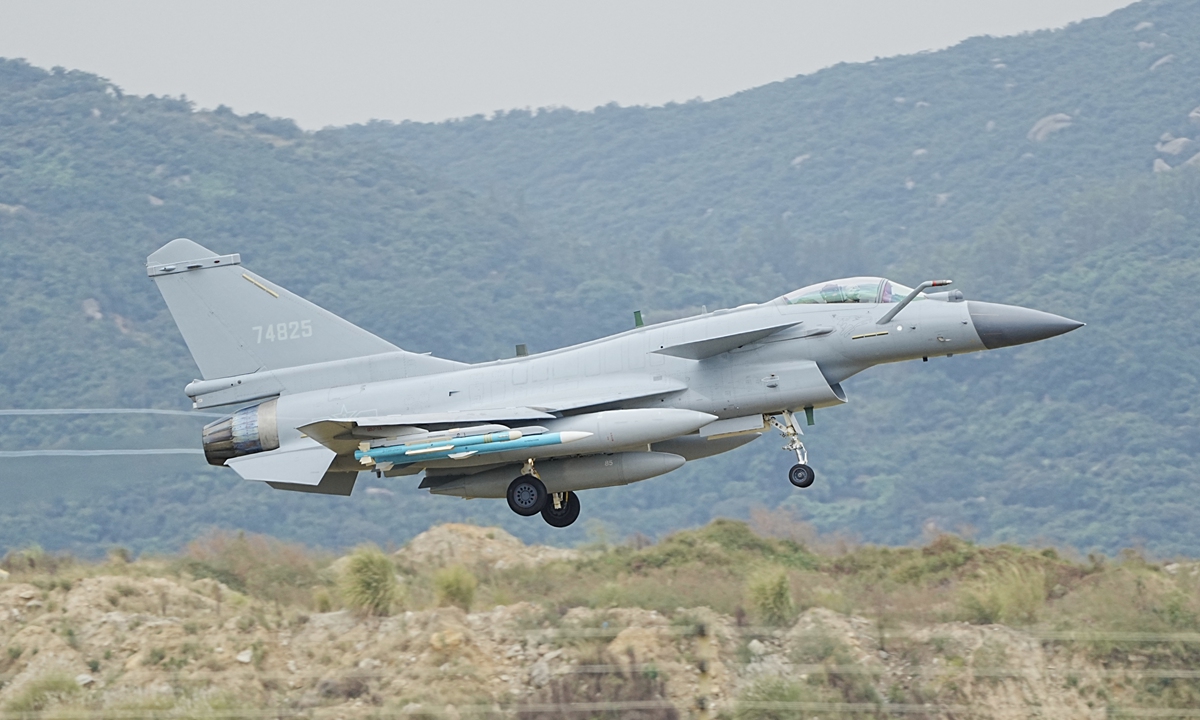
An expert highlighted the involvement of China's J-10C fighter jet, saying it again demonstrates the aircraft's maturity and combat capability.
The two sides will conduct training in a range of areas, including force deployment, joint air defense and humanitarian medical rescue, according to the report.
China's Y-20 transport aircraft, J-10C fighter jet and J-10S fighter-trainer, and JAS 39 Gripen fighter jet and Alpha Jet light attack/trainer aircraft from Thailand participate in a drill in a video posted by CCTV.
In terms of aircraft configuration, the J-10C is one of the PLA Air Force's main combat assets.
Its deployment overseas once again demonstrates its mature and reliable combat capability, Wang Yanan, editor-in-chief of Aerospace Knowledge magazine, told the Global Times on Thursday.
The Y-20 undertakes large-scale transport missions, ensuring the long-range delivery of air defense equipment, aviation materials and other technical support needed for the exercise.
The combination of fighter jets, early warning aircraft, tankers and large transport aircraft forms a complete small-scale overseas deployment and combat validation system, the expert said.
In terms of exercise subjects, joint air defense holds practical significance in the current international context, as low-altitude or medium-to-high-altitude, low-speed or high-speed targets pose significant threats to cities and specific protected assets, Wang said.
Through the joint air defense drills, China and Thailand can further coordinate task allocation and target identification, as well as strengthen coordination between different participating forces.
Humanitarian relief is a routine subject in which the Chinese military has long participated and accumulated considerable experience.
This joint exercise not only tests long-range delivery and deployment capabilities but also reflects the practical defense cooperation between the two countries, Wang added.
In July, Jiang Bin, a spokesperson for the Ministry of National Defense, said China will send multiple types of aircraft and units to the exercise, including ground-based air defense forces to the joint air exercise, per the Xinhua News Agency.
The two sides will carry out air defense, humanitarian assistance and disaster relief exercises, Jiang added.
It is the ninth training event of its kind between the two air forces and is aimed at further deepening traditional friendship and practical cooperation between China and Thailand, he said.
More broadly, Wang said, recent joint exercises between the PLA Air Force and foreign militaries have yielded multiple benefits, primarily on two levels.
"First, they lay the groundwork for potential future joint operations. Second, joint exercises themselves contribute to regional stability," he said.
"When friendly countries in the region reach consensus on security issues and conduct regular military cooperation, it has a stabilizing effect on regional security."
This exercise marks the fifth consecutive year that China and Thailand hold the "Falcon Strike" series joint air force training in Thailand.
。 DENVER -- Colorado’s highest court on Monday upheld the search of Google users' keyword history to identify suspects in a 2020 fatal arson fire, an approach that critics have called a digital dragnet that threatens to undermine people's privacy and their constitutional protections against unreasonable searches and seizures. However the Colorado Supreme Court cautioned it was not making a “broad proclamation” on the constitutionality of such warrants and emphasized it was ruling on the facts of just this one case.At issue before the court was a search warrant from Denver police requiring Google to provide the IP addresses of anyone who had searched over 15 days for the address of the home that was set on fire, killing five immigrants from the West African nation of Senegal. After some back and forth over how Google would be able to provide information without violating its privacy policy, Google produced a spreadsheet of sixty-one searches made by eight accounts. Google provided the IP addresses for those accounts, but no names. Five of the IP addresses were based in Colorado and police obtained the names of those people through another search warrant. After investigating those people, police eventually identified three teens as suspects.One of them, Gavin Seymour, asked the court to throw the evidence out because it violated the Fourth Amendment's ban on unreasonable searches and seizures by being overbroad and not being targeted against a specific person suspected of a crime. Search warrants to gather evidence are typically sought once police have identified a suspect and gathered some probable cause to believe they committed a crime. But in this case, the trail had run cold and police were seeking a “reverse keyword” warrant for the Google search history in a quest to identify possible suspects. Since the attack seemed targeted, investigators believed whoever set fire to the house would have searched for directions to it.The state Supreme Court ruled that Seymour had a constitutionally protected privacy interest in his Google search history even though it was just connected with an IP address and not his name. While it also said it assumes that the warrant was “constitutionally defective” for not specifying an “individualized probable cause”, the court said it would not throw out the evidence because police were acting in good faith under what was known about the law at the time. The court said it was not aware of any other state supreme court or federal appellate court that has dealt with this type of warrant before.“Our finding of good faith today neither condones nor condemns all such warrants in the future. If dystopian problems emerge, as some fear, the courts stand ready to hear argument regarding how we should rein in law enforcement’s use of rapidly advancing technology. Today, we proceed incrementally based on the facts before us," it said. In a dissent, Justice Monica Marquez said such a wide-ranging search of a billion Google users' search history without a particular target is exactly the kind the Fourth Amendment was designed to stop.“At the risk of sounding alarmist, I fear that by upholding this practice, the majority’s ruling today gives constitutional cover to law enforcement seeking unprecedented access to the private lives of individuals not just in Colorado, but across the globe. And I fear that today’s decision invites courts nationwide to do the same,” she said in the dissent, which Justice Carlos Samour joined in. In a statement, Google said it was important that the court's ruling recognized the privacy and First Amendment interests involved in keyword searches. “With all law enforcement demands, including reverse warrants, we have a rigorous process designed to protect the privacy of our users while supporting the important work of law enforcement,” it said. The ruling allows the prosecution of Seymour and Kevin Bui, who were 16 at the time of the Aug. 5, 2020, fire, to move ahead in adult court on charges of first-degree murder, attempted murder, arson and burglary. Investigators allege Bui organized the attack on the home because he mistakenly believed people who had stolen his iPhone during a robbery lived there.Telephone messages and an email sent to Seymour's lawyers, Jenifer Stinson and Michael Juba, were not immediately returned. A lawyer for Bui, Christian Earle, could not be reached for comment. A third teen, Dillon Siebert, who was 14 at the time and originally charged as a juvenile, pleaded guilty earlier this year to second-degree murder in adult court under a deal that prosecutors and the defense said balanced his lesser role in planning the fire, his remorse and interest in rehabilitation with the horror of the crime. He was sentenced to 10 years behind bars.。
Current article:http://www.rangnehongranlinren.bond/czwcz4/dtiu1.htm
Published on:07:16:52