


模范秘书
Australia's defense‑funded report hypes risks to subsea cables to 'serve military goals'_我的网站

一 |
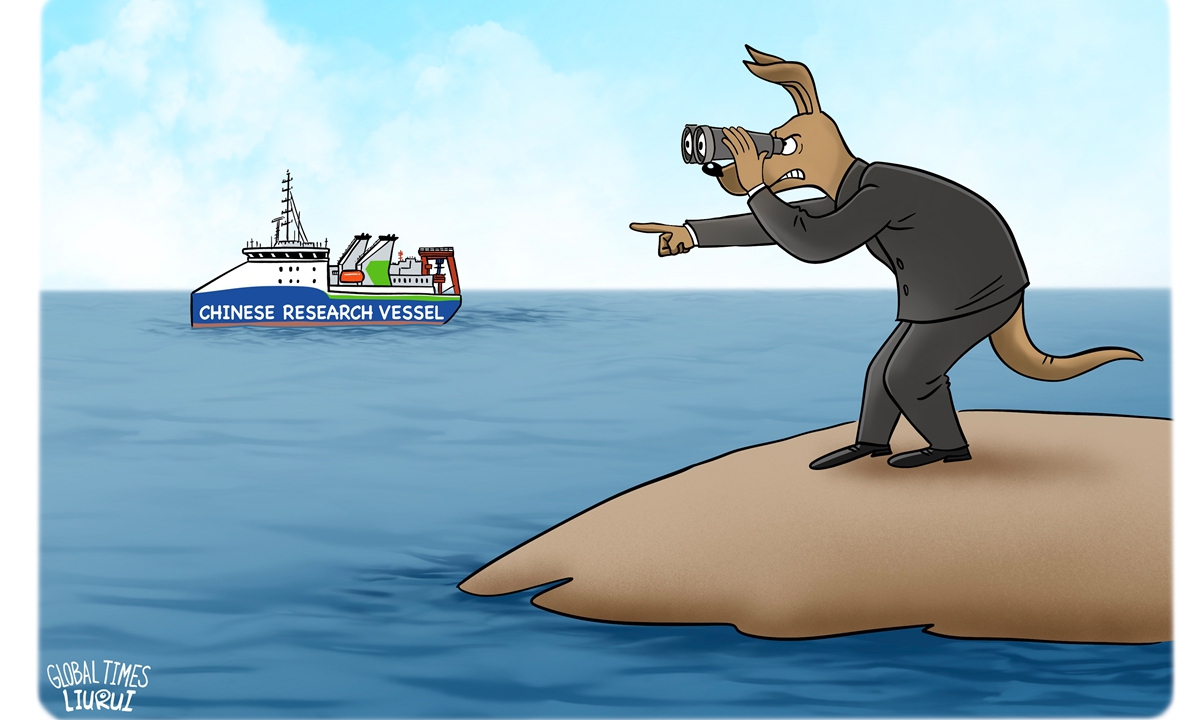
Published by the National Security College at the Australian National University (ANU), the paper claimed recent damage to cables in the Baltic Sea and around China's Taiwan region suggests "state actors are now actively probing and testing cable infrastructure in peacetime as part of broader hybrid warfare strategies" to rapidly degrade connectivity at the outset of a conflict, The Australian reported.
The paper claimed 16 privately owned subsea cables that carry 99 percent of Australia's internet traffic are a "high priority target" for Australia's adversaries that could be severed in a conflict, threatening the nation's economy and social fabric, according to The Australian.
The report singled out China and Russia for blame, saying that there have been multiple apparent attacks on submarine cables in recent years in European waters as well as near China's Taiwan region, suspected to be linked to Russia and China, the Straits Times reported.
However, the report cites a 2025 voyage by Chinese research vessel Tan Suo Yi Hao along Australia's western and southern coastlines as evidence to back its claim that "potential adversaries are actively gathering information about Australia's cable infrastructure."
This report, relying on the routine scientific operations of a Chinese research vessel in 2025 to level allegations of offensive actions against China, and employing ambiguous terminology such as "suspected" and "potential," demonstrates Australia's evidentiary leap, Chen Hong, director of the Australian Studies Center of East China Normal University, told the Global Times on Monday.
This erroneous claim was refuted by the Chinese Foreign Ministry at the time. Chinese Foreign Ministry spokesperson Guo Jiakun said on March 31, 2025 that China carries out normal activities at sea in accordance with international law, including UNCLOS.
"We hope Australia will have a right understanding of this and stop the groundless suspicion and speculations," Guo added.
This is not the first time certain Australian politicians has leveled baseless accusations of China intending to sabotage its undersea cables. Back in May, Defense Minister Richard Marles claimed during the Shangri-La Dialogue that China ought to boost transparency around its maritime operations. He also asserted that a surge in damage to subsea cables had transformed the seabed into a "battlefield," per The Australian.
Chen said Australian side's scaremongering is tied to its predictive threat‑perception framework forged in recent years. This framework designates China and other countries as strategic competitors in advance, subsequently forces routine scientific activities into a confrontational framework, Chen said.
Apart from unfounded allegations against China, the paper claims Australia's defense military "must incorporate the defense of submarine cable infrastructure into its operational planning," according to The Australian.
It added the government should also consider up¬grading an auxiliary ship operated by the navy, ADV Guidance, to enable it to repair damaged cables.
The vast majority of submarine cable damages are caused by accidental factors such as fishing operations and vessel anchoring, rather than deliberate sabotage. For suspected cases of intentional damage, independent technical investigation bodies should be established, and the principle of "investigate first, characterize later" should be strictly applied, so as to prevent ordinary maritime accidents from escalating into diplomatic conflicts, Chen said.
The core problem of Australian side's submarine cable security lies entirely with itself. Instead of addressing its own infrastructure shortcomings and improving its domestic protection and maintenance systems, the Australian side has chosen to continually exaggerate external threats and stoke bloc confrontation, the expert added.
Chen said that by fabricating alleged Chinese threats, Australian side seeks to "rationalize" its military spending increases and underwater force expansion. The submarine digital infrastructure originally meant to serve global development has been labeled along us versus them lines, and this constitutes the biggest hidden danger, he added.
。
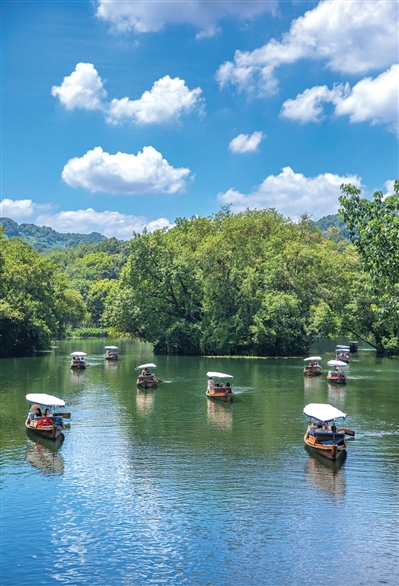 昨天上午,西湖上空蓝天白云,风光如画。 记者 陈中秋 摄今天开始,杭州又将开启一连串的阴雨天气。杭州市气象台分析称,随着台湾岛附近的低压系统逐渐北抬,受到其外围东风气流的影响,杭州转为多阵雨或雷雨的天气。
二 | 具体来说,今天多云到阴,有阵雨或雷雨,部分地区中雨,雷雨时局地可伴有短时暴雨和6~8级雷雨大风等强对流天气;明天阴有阵雨或雷雨。气温方面,今天最高气温31℃,最低气温26℃,平均相对湿度75%,看起来气温不高,但比较闷热。

三 | 大家做好心理准备,从今天开始一直到24日,杭州都有雨水影响,最近出门记得带伞。有一种高温叫“隐形高温”杭州最高气温已经连续好几天低于35℃高温线,但感受不到丝毫凉快。有网友说“凌晨3点多被热醒爬起来开空调”,连中央气象台都感叹说,“前段时间去浙江出差,没空调是真的不行”。近期虽然高温强度不强,但相对湿度较大,所以闷热感明显。中国天气网表示,33℃左右的气温加上较大的湿度,体感温度也会超过35℃,属于“隐形高温”。最近,气象部门基于通用气象体感计算公式,特别开发了一款“体感温度计算器”(打开“杭州天气”微信公众号,点击下拉菜单“气象服务”板块中的“DIY体感温度”功能,即可使用)。记者试着算了下,昨天中午11点左右,实时气温显示为33.2℃的情况下,如果站在太阳直晒的沥青路面上,体感温度高达38.6℃。如果想知道自己所处环境的体感温度,你也可以去试一下。在“不是高温,胜似高温”的日子里,我们再次提醒大家,虽然已经立秋,但杭州的夏天远没有结束,还是要做好防暑降温工作。台风“沙德尔”冲着江浙沪来了?据中央气象台消息,今年第18号台风“沙德尔”(热带风暴级;英文名称:Saudel;名字来源:密克罗尼西亚;名称意义:密克罗尼西亚波纳佩岛传说中的将领“苏迪罗”信任的卫兵)于昨天上午在西北太平洋洋面上生成,中心附近最大风力有8级(18米/秒)。预计,“沙德尔”将以每小时15~20公里的速度向北偏西方向移动,强度逐渐增强,趋向琉球群岛以东洋面。由于距离较远,未来5天对我国海域无影响。有网友问,台风“沙德尔”会不会又是冲着江浙沪来的?目前还不能确定。据中国气象频道气象分析师信欣此前分析,它总体会先向西北方向移动,但后期路径不确定性大。临近琉球群岛时,要根据台风强度、副热带高压强度位置,以及东北一带冷槽和冷空气情况来判定。

四 | 如果冷空气强,副热带高压东退就是转向去韩国或日本。如果冷空气弱,副热带高压强,也可能引导台风来我国。另一边,南海热带扰动也已于昨天下午5点加强为热带低压,其中心位于海南省文昌市偏东方向约270公里的南海北部海面上,外围最大风力有7级(15米/秒)。预计,该低压今日将以每小时5~10公里的速度向偏西方向缓慢移动,穿过海南岛后移入北部湾海面,强度变化不大。受其影响,这两天,华南沿海、南海、巴士海峡等海域有6~7级、阵风8~9级的大风;华南南部及浙江东部、福建东部、台湾等地有强降雨,海南西部局地累计降雨量超400毫米。正值暑假,如你和家人正计划前往上述地方,还请关注当地天气预报。
Current article:http://www.rangnehongranlinren.bond/pkg6/pilb.doc
Published on:00:57:14