镜子超人
Military Experts: CIA & NATO Commandos Deployed in Ukraine Show Kiev is Proxy in US War on Russia_我的网站

A | "I believe the New York Times report is correct in every detail," says Philip Giraldi, a former CIA station chief and military intelligence officer. "It is what I have been hearing. There is considerable training at the Grafenwoehr, Germany army base to familiarize the Ukrainians with the new weapons arriving. Meanwhile there are cadres of special operations soldiers and intelligence personnel operating primarily in western Ukraine. They are not in uniform and many of them are working under various cover designations, including sometimes loose affiliations with foreign embassies and NGOs. All of which means that Biden and other Western leaders are lying about their active participation in the conflict.",Ahead of the Russian special operation to demilitarize and de-Nazify Ukraine, the US withdrew its own 150 military instructors. However, some CIA operatives continued their service in the country secretly, directing most of the intelligence flow the US is sharing with Ukrainian forces, according to the NYT. In addition to that, commandos from Washington's NATO allies have been managing the flow of weapons and equipment in Ukraine and providing training. The NYT specifies, citing American and other Western officials that the commandos are not on the front lines with Ukrainian troops.,Even though the US and NATO member states do not acknowledge that their personnel are operating in Ukraine, Russia and other intelligence services around the world are aware of this, according to the newspaper.,"The potential downside for the president comes when some of these soldiers in mufti get killed or, worse, captured and start to talk about their role," says Giraldi. "The Biden Administration has staked its reputation and possible political future on enabling Ukraine to survive without succumbing to Russian demands.",Deploying CIA personnel (which encompasses military as well as intelligence operatives) "is completely typical of the initial stages of a US-backed long war, and for long-term political manipulation of the target country," according to retired US Air Force Lt. Col. Karen Kwiatkowski, a former analyst for the US Department of Defense.,"This is the future that neoconservative 'strategists' in DC and their British and European allies imagine for Ukraine," Kwiatkowski highlights. "Rather than a negotiated conclusion, with a new Ukrainian role as a neutral and productive country, independent of both Russian and US political influences, the US government and CIA see Ukraine as an expendable yet useful satrap in its competition with the Russian Federation.",The ex-DoD analyst emphasizes that the effort is serious, given that the funding for CIA operations and arms sales and support and training has been flowing freely from Congress and President Biden. It also means that the intel operations in and around Ukraine are "of critical importance" to Washington, according to her.,Situation in UkraineNATO is De Facto at War With Russia but is Using Ukraine as a Tool, US Scholar Says5 April, 17:37 GMT,Ukraine is Washington's Proxy in Effort to Destroy Russia,"Ukraine was being used long before 2021 and 2022, as a US proxy, for global money laundering by multiple players, and for CIA political operations," explains Kwiatkowski. "The US diplomats and the CIA view Ukraine and its various people as pawns on a chessboard they can manage. Given that the US people are not willing to engage in a ground or air war with Russia over Ukraine, those pawns might need to be preserved for the next stage.",Washington's current interest in Ukraine dates back to at least the George W. Bush era, and probably much earlier, with the US foreign policy establishment making steady efforts to drive a wedge between Russia and its neighbor, according to the military veteran. Washington has made considerable financial, diplomatic and political investment in Ukraine over the recent decades and it cannot afford "losing" it.,"Coming on the heels of similar 'losses' in Afghanistan, Iraq, Libya, Syria, and potentially some of the Gulf states, there are those in Washington who would find the complete loss of Ukraine unacceptable," she stresses.,The US is equally involved in former Soviet and Warsaw Pact countries, such as Lithuania, and Poland, to take the post-Soviet space under control "as part of the war to maintain US influence and contain Russian influence," according to the former Pentagon analyst. "Recent Lithuanian steps to enforce EU sanctions on the Russian Baltic Sea trade port and naval city of Kaliningrad speaks to the nature of what is to come, in the eyes of the US strategists," she points out.,"Ukraine is a proxy; the West is trying to destroy Russia, it's that simple," echoes Larry Johnson, a veteran of the CIA and the State Department’s Office of Counter Terrorism, which provided training to the US Military’s Special Operations taskforce for 24 years. "It would be one thing if Russia was the most evil, oppressive, authoritarian regime in the world. It's nowhere even close. Even though the West keeps trying to portray Russia as such. The fact of the matter is, the West wants the resources that Russia has and it wants to control Russia. Russia is not about to be controlled.",Situation in UkraineEx-CIA Analyst: US Military Aid Not a Game Changer for Kiev, Ukraine Has Already Lost6 June, 16:31 GMT,US Trying to Find the Way Out of Ukraine's Mess,Despite CIA and NATO personnel being deployed in Ukraine and NATO weapons constantly flowing to the country, Ukrainian troops have been increasingly outgunned by DPR/LPR military groups backed by Russia, acknowledges the NYT.,The newspaper names a number of reasons behind the Ukrainian Armed Forces' failures, including limited time for training to use sophisticated NATO weapons; huge losses among the "most battle-hardened" and well-trained Ukrainian forces; and certain limits to the expertise of the CIA, which is traditionally focused on counter-intelligence, among other matters.,"This is the fault of Hollywood," says Johnson. "There's always the assumption that all these CIA personnel are really some terrific people. They've got magical training capabilities. They don't. The CIA hasn't won a single insurgent war in the last 40 years, except going back to supporting the mujahedeen against the Soviets in Afghanistan. They're hoping to try to recreate that miracle. But again, the problem is the people who are assigned militarily to this kind of CIA activity are either retired, special forces, special operations personnel who had to get out because they were either physically unable to perform according to military standards, or it's people who've always wanted to do that kind of thing but really have had no special training in it.",Situation in UkraineUS Military Expert: Russia to Score Major Victories in Donbass, Must Adapt to New NATO Game22 May, 17:55 GMT,The former CIA analyst raises the question about the timing of the NYT exposure. He notes that it has never been a secret that in every foreign conflict the US was interested in, the US has routinely provided training and assistance, and dispatched the CIA's Special Activities Division to operate on the ground. Why is NYT openly writing about it now?,"I think the answer lies in the very last paragraph, last sentence of the article, where it is said: 'Would the enhancement of training be worth the possible price that is going to have to be paid?' The answer is 'probably not.' In other words, this is a gesture to show 'yeah, look, we're doing everything we can do to help the Ukrainians, we've provided we've provided special forces, special operations forces, we've brought them into other countries, we're sending our own people there, the CIA and their passive intelligence, so they can target Russian positions.' But when all is said and done, doing more is not going to really help.",According to Johnson, the NYT piece is "really sending a signal that the United States is trying to figure out how to disengage from this mess.","I think the purpose of this article coming out now is just to lay the groundwork for why we can't put or shouldn't put any more US military personnel or even CIA personnel inside Ukraine," the CIA veteran emphasizes. "Because continuing to put US personnel, whether they're CIA or military, inside Ukraine to train, is becoming too risky because of Russia's success on the battlefield."。
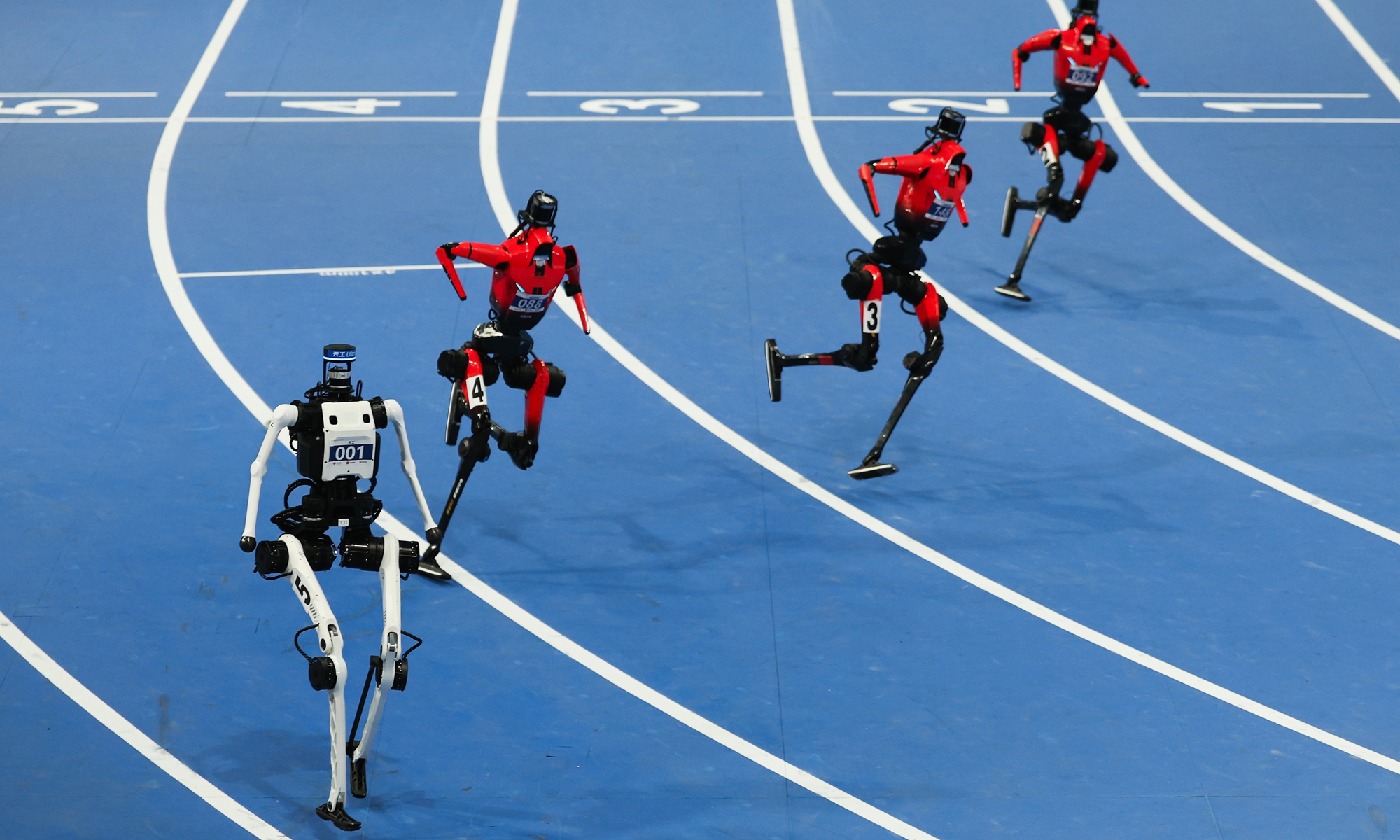
A Tien Kung robot (left) competes in the 400-meter race at the National Speed Skating Oval in Beijing on August 23, 2026 during the 2nd World Humanoid Robot Games (WHRG). Photo: VCG
On the blue track inside the National Speed Skating Oval, robots chased each other in the 400-meter race. A sprinting Tien Kung robot was tripped by a rival robot lying on the track but did not fall. Instead, it adjusted its posture in seconds and continued toward the finish line with a result of 38.15 seconds, breaking human 400-meter race world record of 43.03 seconds, held by South African athlete Wayde van Niekerk.
This scene unfolded on Sunday, the first official competition day of the 2nd World Humanoid Robot Games (WHRG). Later that evening, a humanoid robot named Lightning, developed by Honor Co., broke the long-standing human 1,500-meter world record of 3:26 set by Moroccan athlete Hicham El Guerrouj with a time of 2:30.22. Just one night earlier, during the opening ceremony's 100-meter sprint and high jump demonstrations, humanoid robots had already shattered records long held by human athletes Usain Bolt and Javier Sotomayor — merely an appetizer for the five-day sci-fi spectacle.
The Games have attracted 666 teams from 16 countries across six continents, up 138 percent from its inaugural edition. The number of participating robots quadrupled to 2,056, the Global Times learned from the organizing committee.
Yet the biggest change this year was not only the scale, but also the technological maturity. More teams have shifted from remote-controlled robots to fully autonomous systems. Chinese observers, after watching several events, said humanoid robots are no longer limited to simple demonstrations of walking or dancing. Increasingly, they are being tested in environments that demand speed, coordination, perception and decision-making.
From movement to intelligence
Behind the record-breaking performances are a series of technological upgrades. During the running events, Global Times reporters observed that robots were able to make subtle movements around their hip joints while walking, allowing them to maintain balance and produce movements closer to human biomechanics.
Guo Yijie, technical director of Tien Kung Ultra, said the improvement came from advances in hardware design.
"Robot joints have improved in torque and speed. As competitions demand higher power output, the reliability of the main control board, power board and high-power battery discharge capability have become increasingly important," Guo told the Global Times.
According to Guo, the same Tien Kung Ultra robot was used in both sprinting and jumping events. For running, the waist needs rotation to balance the inertia generated by leg movements. For jumping, the upper body requires pitching movement to help the robot achieve greater distance or height, Guo said, noting that these can all be achieved with only slight adjustments to the waist configuration were needed, and it highly demonstrated to the robot design's flexibility.
Besides the hardware upgrades, developments in robots' faster decision-making in "brains' is better showcased in football competitions.
The Booster T2 robot used by many domestic and overseas football teams has increased its onboard computing capability by 10 times compared with the previous generation. The time from recognizing the goal to deciding whether to pass or shoot has been reduced to around 100 milliseconds - faster than the time humans usually need to blink.
Cheng Hao, a technical representative from Boosters Robotics, said the improvement represents an "end-to-end" transformation in embodied intelligence.
"In the past, robots relied on separate steps: perception, planning, decision-making and execution. Each stage was disconnected. Now, with an end-to-end motion foundation model, visual input can directly generate joint control commands," Cheng said.
The newly introduced table tennis and tennis competitions are also testing another important capability: perception.
"Robots are moving from simply recognizing the three-dimensional position of a ball to understanding the movement information of opponents and more complex environments," said Li Yinghui, a postdoc researcher and the leader from the Hong Kong University team at the table tennis event. Such capabilities developed in sports scenarios could eventually be transferred to other scenarios in industries or daily life, Li said.
Beyond entertainmentThough clips from the robot competitions have made a buzz on social media, with some critics from Western media questioning why robots need to dance, play football or compete in athletics while arguing that these activities appear far from everyday needs.
Zhou Changjiu, Vice President of the RoboCup Federation and the Robotics Competition Association of the Asia-Pacific (RCAP), stressed robot sports are not designed for entertainment alone. "Robot competitions are testing the capabilities needed for humanoid robots to enter the real world," Zhou told the Global Times.
Different events evaluate different abilities. Sprinting tests speed, marathons examine battery endurance and energy management, while football provides a comprehensive test because of its dynamic and unpredictable nature, testing intelligence, manipulation, interaction, safety, cost and trust at the same time, Zhou said.
Unlike a single-task demonstration, football requires robots to cooperate. Players must understand their own roles, recognize teammates and opponents, and make collective decisions - a form of swarm intelligence that could become essential when robots work together in homes, factories and emergency rescue environments.
Entertainment, however, can generate business opportunities. Gu Jinghai, brand director of EYOU Robot Co, told the Global Times that the company sold 95,000 integrated joints in China in 2025 and expects sales to exceed 1 million units in 2026. Growth mainly comes from planetary joints used in entertainment robots, while harmonic joints for industrial robots are also expanding steadily, he said.
Jiao Jichao, an executive from UBTECH Robotics, said the criticism that "Chinese robots can only sing and dance" reflects only a temporary stage of development. "Performance and dancing are also real commercial demands, and their existence has value," Jiao said. "Beyond entertainment, Chinese robots are already demonstrating intelligent capabilities that support practical applications in manufacturing, and partnerships with companies including Huawei and Foxconn, where robots have already entered production lines in small-scale applications."
The Outline of the 15th Five-Year Plan for National Economic and Social Development of China stated that the country will construct a comprehensive cultivation system for future industries including the embody intelligence as new economic growth drivers.
Zhou said the development of humanoid robots is not only about individual machines, but about building an entire ecosystem.
China's advantage lies in its complete supply chain, abundant application scenarios and manufacturing capabilities, while the fast growing industry still faces challenges such as the lack of unified standards.
Gu said the company has launched mass production of robotics joint under domestic standard of auto parts.
Robot competitions can help address these issues by creating common standards in areas such as competition rules, robot dimensions, communication systems, batteries and joint modules. "As applications expand, the cost of key robot components will continue to decline," Zhou said.
"Numbers are magic," Zhou said. "If producing one robot costs a huge amount because it is handmade, producing one million robots will completely change the cost structure."
For humanoid robots, the race taking place inside the Ice Ribbon may not ultimately be about who crosses the finish line first. It may be about whether these machines can learn to navigate the far more complicated race outside the stadium - the race into the real world.
。
Current article:http://www.rangnehongranlinren.bond/pxz/4hm6dbw.html
Published on:21:38:35


